
Handing over responsibility for health and healthcare


Handing over responsibility for health and healthcare
At age 18, most young adults are legally able to make decisions about their health and healthcare, but it is unclear whether they are prepared to take on those responsibilities. The C.S. Mott Children’s Hospital National Poll on Children’s Health asked a national sample of parents about whether their young adult child age 18-25 takes responsibility for their own health and healthcare.
In describing which of six basic healthcare tasks their young adult child mainly handles themselves, most parents say their child communicates with providers during a visit (71%), follows the provider’s instructions after the visit (71%), arranges transportation to appointments (69%), provides insurance and family history information (56%), schedules appointments (52%), and decides when a healthcare visit is needed (49%) themselves. While 58% of parents say their young adult child handles at least 4 of these 6 basic healthcare tasks themselves, 17% say their child handles none of them. Parents cite barriers to their young adult child becoming more responsible for their own healthcare as lack of knowledge about what to do (27%), not enough practice doing it (25%), not being mature enough (16%), or not wanting to take responsibility (15%); 43% say there are no barriers.
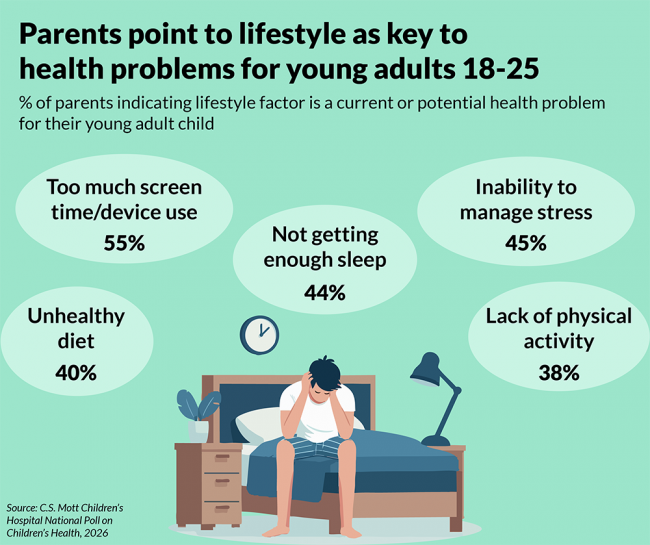
Some parents cite their young adult child’s mental health conditions (37%) or chronic medical conditions (20%) as a cause of current or potential health problems. More parents cite lifestyle challenges as current or potential health problems for their young adult child, including too much screen time/device use (55%), inability to manage stress (45%), not getting enough sleep (44%), unhealthy diet (40%), lack of physical activity (38%), loneliness/lack of friends (33%), and behaviors like vaping/smoking (18%), use of legal substances (17%), or use of illegal substances (7%). Forty percent of parents view the cost of maintaining a healthy lifestyle as a problem.
About half of parents (53%) rate themselves as excellent/very good in preparing their young adult child to be responsible for their own health and healthcare; 31% rate themselves as good, and 16% fair/poor. Parents who rate themselves as fair/poor (compared to excellent/very good) are more likely to report their young adult child handles none of the basic healthcare tasks (39% vs 10%) and more likely to say their child’s unhealthy lifestyle is a cause of current or potential health problems.
Highlights
- Half of parents rate themselves as excellent or very good in preparing their young adult child to be responsible for their own health and healthcare.
- 1 in 6 parents report their young adult child does not handle any basic healthcare tasks.
- 2 in 5 parents view the cost of maintaining a healthy lifestyle as a problem for their young adult child.
Implications
In this Mott Poll, parents evaluated their progress in preparing their young adult children to assume responsibility for their own health and healthcare. These two responsibilities are related but distinct.
Managing one’s health is something that happens every day, and parents have endless opportunities to prepare their child to take on that responsibility. In this Mott Poll, parents indicated that behaviors and lifestyle are more likely to cause health problems for their child, more than chronic medical or mental health conditions. Therefore, teaching teens and young adults to make healthy choices is key to them learning to manage their health. An everyday opportunity could be involving them in grocery shopping and meal planning, to get them thinking about the components of a healthy diet. Another strategy is for parents to describe their own health-related behaviors, from scheduling time for exercise to limiting their screen time, to help young adult children understand the steps to maintaining a healthy lifestyle.
In contrast, managing healthcare centers on interactions with the healthcare system, from health insurance to the variety of healthcare settings and providers. This system is complicated, even for parents, and navigating the different components requires a considerable amount of knowledge. Furthermore, many healthcare tasks (such as signing up for health insurance, finding a provider, or scheduling a preventive care visit) occur infrequently, so there are limited opportunities for youth and young adults to gain experience and confidence. Parents should take advantage of these limited opportunities to teach their children about how the healthcare system works, starting with the teen years, so that by the time that child reaches adulthood, they have a basic understanding of how the system works. For example, when renewing the family health insurance coverage, parents can show their child the information and give a brief explanation of the options.
Findings from this Mott Poll suggest that parents have had the most success preparing their young adult children to take an active role during health care visits; this includes communicating with the provider about symptoms and questions, as well as understanding and following provider instructions. Less often, young adult children are prepared to determine when a visit is needed, or how to schedule that visit.
A key time for young adults to gain knowledge and experience about the healthcare system is when they move from a pediatric provider to a provider that serves adults. Often this occurs between 18 and 21 years of age. Parents should explain the difference between a primary care provider and a specialist, and involve their child in selecting their adult provider. The first visit at the adult clinic offers an excellent opportunity for young adults to practice managing their healthcare; often the first visit requires filling out information about health insurance, family history, and personal health history (e.g., allergies, medical conditions). These forms should be completed by the young adult child; the appropriate parent role is explaining what the forms are asking, without taking over. If parents attend the first visit, they should take a back seat, allowing their young adult child to handle scheduling, check-in, and interactions with the provider.
For parents whose child has a medical or mental health condition, it is particularly important to ensure that child understands the nature of their condition, the names of their medications and how to obtain their prescriptions, the frequency of visits to monitor their condition, and the things that alleviate or trigger their symptoms. This education should begin early, with the child gradually taking more ownership, so that by young adulthood, they are ready to be fully responsible.
Data Source & Methods
This report presents findings from a nationally representative household survey conducted exclusively by Ipsos Public Affairs, LLC (Ipsos) for C.S. Mott Children’s Hospital. The survey was administered in February 2026 to a randomly selected, stratified group of adults who were parents of at least one child age 13-25 years living in their household (n=2,101). Adults were selected from Ipsos’s web-enabled KnowledgePanel® that closely resembles the U.S. population. The sample was subsequently weighted to reflect population figures from the Census Bureau. The survey completion rate was 69% among panel members contacted to participate. This report is based on responses from 1,550 parents with at least one child age 18-25. The margin of error for results presented in this report is ±1 to 7 percentage points.
Findings from the C.S. Mott Children’s Hospital National Poll on Children’s Health do not represent the opinions of the University of Michigan. The University of Michigan reserves all rights over this material.
Citation
Clark SJ, Gebremariam A, Schultz SL, Woolford SJ. Handing over responsibility for health and healthcare. C.S. Mott Children's Hospital National Poll on Children's Health, University of Michigan. Vol 49, Issue 5, July 2026. Available at: https://mottpoll.org/reports/handing-over-responsibility-health-and-healthcare.

